English 中文
faq

WPC vs Wooden Doors Strength Cost and Maintenance Compared

2026-10-02
Full WPC hollow doors and wooden doors differ in moisture response, maintenance, surface options, hardware support, and installed cost. This WPC door vs wooden door comparison helps hotel, apartment, hospital, school, and housing project teams select a door system for each room condition and procurement plan.
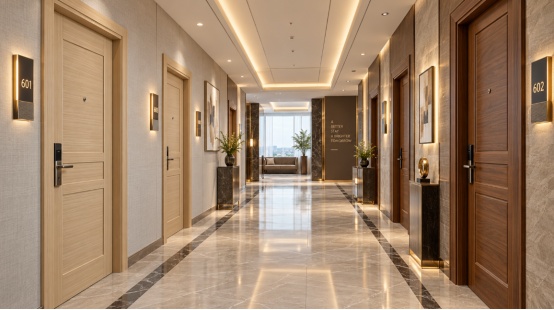
Hotel hallway with contrasting light and dark wood doors
 

Full WPC Hollow Door and Wooden Door Construction

WPC means wood plastic composite. Yingkang full WPC hollow door panels combine wood powder, PVC resin powder, polymer resin, and additives through high-temperature extrusion. The integrated WPC door panel has a hollow internal profile and uses an adhesive-free panel structure. Wooden door panels use solid timber or engineered wood such as LVL, MDF, or HDF with paint, veneer, or laminate.
Construction determines performance. A full WPC hollow door panel and a wooden door panel carry different moisture, weight, hardware, and maintenance characteristics. Project specifications should identify the WPC door panel thickness, height, width, WPC door frame or WPC door jamb, surface finish, color, and hardware reinforcement.

Full WPC Hollow Door Structure

A full WPC hollow door panel is formed as one integrated extruded panel. Panel weight varies with dimensions, material formulation, and profile. A dense new-material hollow panel can weigh more than some foamed solid panels. The integrated structure provides impact resistance, nail holding, and dimensional stability. For engineering projects, 40 mm and 45 mm WPC door panel thicknesses are common. Yingkang customizes the WPC door panel height, width, thickness, and matching WPC door frame or WPC door jamb to the approved opening schedule.

Wooden Door Structure

Wooden doors may use solid timber, finger-jointed wood, LVL, MDF, or HDF. Solid wood and LVL can provide strong screw holding. Moisture performance depends on the wood species, core, adhesive, edge banding process, coating, and site humidity.

Full WPC Hollow Door and Wooden Door Comparison by Parameter

The table summarizes typical project considerations. Confirm each item against the quoted construction, sample, technical sheet, and test report.
Parameter Full WPC Hollow Door Wooden Door Procurement Note
Main construction Integrated extruded WPC door panel with a hollow internal profile Solid timber or engineered wood construction Identify the panel, edge, frame, finish, and hardware reinforcement
Water and moisture Waterproof and moisture-resistant; supplied water absorption rate below 0.2% Performance depends on coating, edge banding process, adhesive, and humidity control Specify a compatible WPC door frame or WPC door jamb and sealed installation joint
Insect exposure WPC material is termite-resistant and insect-resistant Natural wood and wood-based cores may require pest treatment Confirm treatment requirements for the destination market
Dimensional stability Integrated WPC door panel resists swelling, cracking, and warping Dimensions change with species, moisture content, temperature, and sealing Approve samples and installation clearances
Strength and weight Supplied test summary records more than 4,000 kg for the tested structure; panel weight varies with dimensions, material formulation, and internal profile Screw holding and weight depend on species, core, size, and construction Request the matching test report and confirm hinge and frame ratings
WPC door panel thickness 40 mm and 45 mm are common for engineering projects; height and width are customizable Varies by solid or engineered construction Match panel dimensions, frame rebate, lock, hinge, and closer
Surface color and design PVC film, vacuum forming, or paint; about 300 colors and 500-plus WPC door moulds are listed Paint, veneer, laminate, or natural timber finish Approve a physical color and texture sample
Cleaning and maintenance Damp-cloth cleaning plus scheduled hardware and surface checks; low routine maintenance Cleaning plus humidity control, coating checks, and refinishing Include labor and materials in the life cycle budget
Environmental documentation Listed specification reports E0 grade and formaldehyde emissions not detected Depends on timber, panel, adhesive, coating, and certification scope Request reports for the quoted construction and destination market
Typical project fit Hotels, apartments, hospitals, schools, bathrooms, kitchens, and coastal projects Dry interiors and designs that specify natural timber Select by room conditions, design brief, and maintenance plan

Strength Impact Resistance and Hardware Support

Door strength includes impact resistance, nail holding, hardware support, edge stability, and shape retention. Yingkang's supplied comparison records a load-bearing test result above 4,000 kg for the tested full WPC hollow door structure. Buyers should request the matching test report and confirm the test method, WPC door panel dimensions, WPC door panel thickness, internal profile, and support conditions before applying that result to a project. Wear-resistant PVC film with UV treatment adds scratch and compression resistance to the surface.
Solid timber and LVL can provide strong screw holding. The full WPC hollow door structure provides impact resistance, nail holding, and dimensional stability. Yingkang's supplied technical information records a WPC door panel water absorption rate below 0.2%, supporting moisture resistance and stable dimensions in humid interiors. Wooden door edges and wood-based cores can absorb moisture when their coating or seal is damaged, which can lead to swelling, warping, or cracking.
WPC door panel weight varies based on height, width, door leaf thickness, and profile specifications, typically ranging from 23 to 55 kg. This factor is particularly significant in Middle Eastern markets; clients in Saudi Arabia, Kuwait, the UAE, and Oman place great importance on door leaf weight, regarding it as a key indicator of quality.
Confirm hinge reinforcement, lock-hole position, WPC door frame or WPC door jamb, and closer rating before production. Factory machining from approved hardware drawings reduces fitting work during installation.

Initial Price and Life Cycle Cost

Initial price depends on the quoted system. A full WPC hollow door commonly costs less than a solid wood door. Yingkang currently prices its WPC skin door near comparable MDF door levels, while the full WPC hollow door uses a different integrated extrusion process and should be quoted separately. Compare doors with the same opening size, panel thickness, WPC door frame or wooden frame, finish, color, hardware, packaging, and test requirements. Yingkang's supplied comparison lists a service life of up to 25 years for the specified full WPC hollow door structure. Installation quality, traffic, climate, cleaning agents, surface damage, and hardware maintenance affect the actual replacement cycle.
A life cycle budget should include cleaning, hardware service, coating or surface repairs, site labor, and replacement. The full WPC hollow door structure supports a long service life and low routine maintenance because the extruded WPC door panel resists moisture, termites, swelling, cracking, and warping. Request a quotation that lists the WPC door panel, WPC door frame or WPC door jamb, architraves, hardware preparation, color, packaging, spare parts, and destination port.

Maintenance Requirements

Full WPC hollow doors require dust removal and cleaning with a damp cloth and a compatible cleaner. Inspect hinges, closers, locks, seals, and WPC door frame fixings on the maintenance schedule. Repair damaged PVC film or paint with the specified material and matching color.
Wooden doors require stable indoor humidity, sealed edges, and regular checks near wet rooms and exterior-facing walls. Maintain the coating and threshold seal, remove standing water, and repair scratches before moisture reaches the substrate.
Include cleaning products, inspection intervals, coating repairs, and replacement parts in the handover manual so the property team can maintain the specified finish.

Fit for Humid and High Use Buildings

Bathrooms, kitchens, and coastal sites expose doors to moisture and frequent cleaning. The full WPC hollow door uses an extruded panel with a reported water absorption rate below 0.2%, and Yingkang describes the material as termite-resistant. Specify the matching WPC door frame or WPC door jamb, sealed installation joints, and compatible hardware. The easy-to-clean interior doors are perfect for hotels and schools. Confirm sound insulation against a test report for the specified door assembly.
Wooden doors suit dry rooms where the design brief calls for natural timber. Specify the edge banding process, coating, and moisture-control plan for the site's humidity conditions.
Yingkang's public profile lists more than 500 WPC door moulds and about 300 color options. Engineering orders commonly use 40 mm or 45 mm WPC door panel thicknesses, with custom heights and widths for the project opening schedule. Confirm the WPC door panel dimensions, hollow profile, wpc door frame and architraves, surface finish, color, and hardware machining before production.
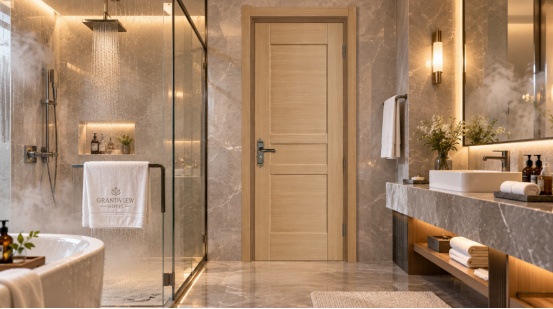
Steamy hotel bathroom with a central light wood door
 

Factory Capacity and Procurement Controls

Project supply requires repeatable door leaf dimensions, controlled surface quality, compatible frames, export packaging, and a delivery plan aligned with the installation sequence. Samples and approved hardware drawings establish the production reference.
Yingkang has manufactured door products since 1997. Its company profile lists a 200,000 m² factory area, 300-plus production machines, four automated production lines, and 600 production staff. Published daily capacity is 6,000 door leaves, 16,200 door frames, and 10,000 door skins. Automated cutting, the edge banding process, lock-hole machining, and hinge-hole machining support regular lead times of about 20 to 30 days, subject to order quantity and specification.
Company records list ISO 9001, ISO 14001, FSC, BV, and CE certification, with market-specific certificates and test reports supplied according to the order. CE supports product compliance documentation for the European market. OEM and ODM services cover WPC door skins, WPC door frames, and architraves. Custom options include colors, dimensions, designs, packaging, and hardware-hole processing.
Review Yingkang wpc door factory’s profile and factory tour when checking product scope, equipment, workshops, and project supply capability.

FAQ

Q1 What determines WPC door vs wooden door cost?
The selected construction sets the initial price. A full WPC hollow door commonly costs less than solid wood. Compare the same WPC door panel or wooden door panel, frame, finish, color, hardware preparation, packaging, and test scope, then add maintenance and replacement costs.

Q2 Are full WPC hollow doors suitable for bathrooms and kitchens?
Yes. The full WPC hollow door structure is waterproof, moisture-resistant, mildew-resistant, and termite-resistant. Specify a compatible WPC door frame or WPC door jamb, hardware set, sealed installation joint, and surface finish.

Q3 Can WPC door panels be customized for a project?
Yes. Engineering orders commonly use 40 mm or 45 mm WPC door panel thicknesses. Yingkang also customizes panel height, width, surface finish, color, WPC door frame or WPC door jamb, hardware holes, and branded packaging.

Q4 How should buyers compare WPC door suppliers?
Check the material formula and door-leaf construction, including the core or filler, profile, thickness, and leaf dimensions. Confirm the frame construction and dimensions, the wall-opening width, height, and wall thickness, sample consistency, test methods, inspection records, destination-market certificates, customization scope, packaging, lead time, spare parts, and hardware machining.

Q5 Which door suits a hotel or apartment project?
Full WPC hollow doors suit bathrooms, kitchens, coastal buildings, and high-use areas that require waterproof material, stable dimensions, low routine maintenance, and wipe cleaning. Wooden doors suit controlled, dry interiors where the design brief specifies natural timber and the maintenance plan includes coating and moisture checks.


Share:
Copyright © 2020 Yingkang All rights reserved.
Technical Support: Coverweb
WhatsApp: +86 18737185148