English 中文
faq

Are WPC Doors Termite-Resistant and Water-Resistant? A B2B Guide

2026-10-09
 
For hotel, apartment, healthcare, and coastal projects, WPC doors provide a wood-fiber and PVC-resin construction with water-resistant performance and resistance to termite feeding. Project buyers should specify the door leaf, frame, edge treatment, hardware, test evidence, and installation conditions together. This guide explains the material limits and the factory details to confirm before placing an order.
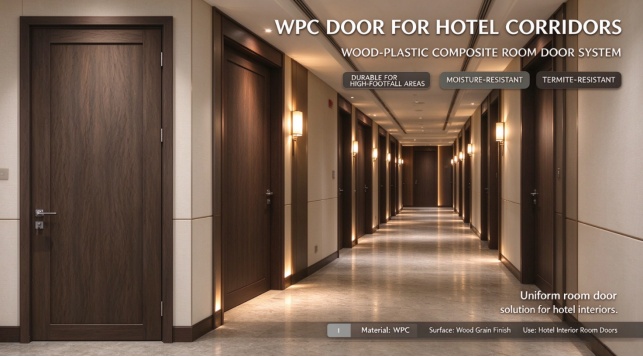
Wood-grain WPC room doors along a hotel corridor
 

What Does Termite Resistance Mean for a WPC Door?

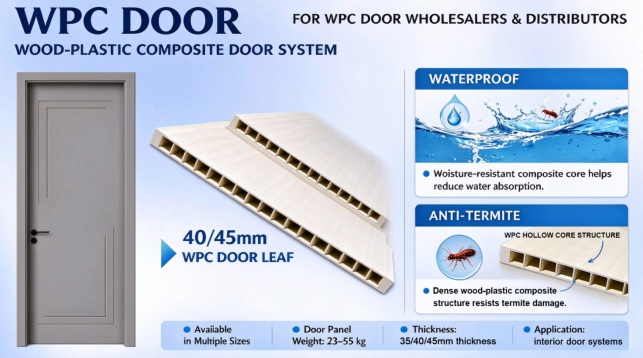
WPC (wood-plastic composite) combines wood fiber or wood powder with PVC resin and additives, then forms the mixture through extrusion. The polymer matrix surrounds the wood particles within the profile, so the exposed solid-wood food source found in timber components is absent from the WPC material. This construction gives the door leaf and frame resistance to termite feeding.
The term termite-resistant describes the material behavior. The result at a building depends on the complete opening: door construction, cut edges, frame, perimeter joints, nearby timber, and installation. For projects in termite-risk areas, specify WPC leaves and frames, sealed edges, and installation details suited to local building conditions. Ask for product-specific test reports when the project requires documented evidence.

Which Markets Specify Termite-Resistant Doors?

Termite resistance is relevant to projects in regions with warm, humid climates and known termite activity. Buyers can assess local building requirements and project exposure for hotels, apartments, schools, healthcare facilities, and coastal developments. The appropriate specification identifies the material, frame, edge sealing, and installation method for each opening.

How Water-Resistant Are WPC Doors?

Integrally extruded WPC profiles have water-resistant properties through the material thickness. The construction limits water absorption and moisture-related swelling in indoor use. A door assembly still includes joints, hardware, and installation interfaces, so project specifications should address those components alongside the leaf material.
WPC doors are used in bathrooms, kitchens, hotels, hospitals, and other humid indoor areas. A PVC film-laminated, vacuum-formed, UV-printed, or painted surface provides a finished face that can be wiped during routine cleaning. Seal the frame-to-wall joint, protect field-cut edges, and follow the installation and care instructions for the selected product.

Hardware and Coastal Installation

Coastal air can affect exposed metal hardware over time. For coastal projects, specify hardware with corrosion resistance suited to the exposure and keep the threshold detail clear for drainage. YingKang can supply compatible door hardware for project use. Confirm the hardware material and finish in the order specification.

Which Construction Details Matter for B2B Projects?

Commercial buyers can review the door leaf, core, skin, frame, finish, inspection records, packaging, and delivery plan as one specification. Request a construction sample that matches the intended opening and hardware, then confirm that the production order uses the approved configuration.

What Skeleton Materials Are Available?

The two sides of WPC hollow door profiles are typically filled with skeletons of different materials, such as wood, LVL, or WPC. A wood skeleton is the most economical and lowest-cost option. An LVL skeleton is multi-layer pressed, denser, and drier than wood, costing about US$1.50 more than the wood skeleton. A WPC skeleton is currently the best infill option: made entirely of pure WPC material on both panel sides, it achieves 100% waterproof and termite-proof performance—making it the ideal choice for coastal markets—though its cost is higher than the other two options. Please confirm the skeleton material and final pricing in the order specification.
WPC skin doors also use a perimeter skeleton in WPC, LVL, or wood. The edge banding process  is a key manufacturing requirement for this construction. YingKang states that its edge-sealing process can achieve up to 99.99% finish consistency; request an approved sample and inspection standard for the selected door skin and skeleton.

Hollow, PU Foam, or Honeycomb Core?

The product range includes integrally extruded hollow WPC doors and WPC molded doors. WPC molded doors can use a honeycomb paper or PU foam board core. Core choice affects the assembly configuration, weight, acoustic performance, and project cost. Confirm the selected core and its test evidence against the room requirements.

What Surface Finishes Are Available?

After a WPC door is integrally formed, the surface can receive several finishing processes. PVC film lamination is a widely used option with wood-grain and solid-color designs. Vacuum forming starts with a CNC-engraved door panel, then applies PVC film by vacuum forming to follow the carved surface and create relief patterns. UV printing prints selected patterns or wood-grain designs onto the surface. Painting is also available for specified colors and finishes. Confirm the finish, color reference, sample, and edge treatment before mass production.

What Quality Checks Should You Request?

YingKang describes a three-tier quality process covering incoming-material inspection, in-process patrol inspection, and finished-product inspection before delivery. Buyers can request the inspection records and product-specific reports or test videos for water resistance, flame retardancy, nail-holding strength, impact resistance, and load-bearing performance. The available evidence depends on the product configuration and test scope; confirm the report details before using them for a project compliance decision.
Protective corners, pearl cotton, and three-layer corrugated cartons form part of the stated export packaging approach. Confirm packaging and container-loading details against the door dimensions, finish, destination, and transport plan.

What Should You Confirm Before Ordering?

Include these items in the RFQ: integrally extruded or assembled construction, door-frame material, leaf thickness, opening dimensions, core type, surface finish and color, edge-sealing method, hardware drilling, test documents, packaging, minimum order quantity, lead time, and container-loading plan.
The company knowledge base lists a standard MOQ of 200 sets for finished doors and 500 pieces for door skins. It lists approximate loading quantities of 200 door sets for a 20GP container and 500 sets for a 40HQ container. Actual quantities depend on door dimensions, packaging, and the loading plan; confirm them with the factory for each order.
Hollow core WPC door leaf with cross-section profile
 

How Can YingKang Support a Door Program?

YingKang's company materials describe a manufacturing operation established in 1997, with 53 extrusion lines, four automatic finished-product lines, more than 600 employees, and a dedicated painting factory. The knowledge base lists finished-door production capacity above 6,000 sets per day. The current website homepage presents a separate operating snapshot: a 200,000 m2 factory area, three automated production lines, and daily outputs of 6,000 door leaves, 16,200 door frames, and 10,000 door skins. Treat these as company-published capacity references and reconfirm the applicable figures for the selected product range and current production schedule.
The company supports OEM and ODM requests for dimensions, colors, door skins, frames, hardware holes, labels, and export packaging. Its stated quality process covers incoming materials, in-process checks, and final inspection. The knowledge base gives a regular-order lead time of 15-20 days; project orders can use a production plan and delivery agreement based on quantity and specifications. Confirm the schedule, capacity allocation, and delivery terms in writing before order confirmation.
For a hotel or apartment rollout, submit the opening schedule, approved sample, finish references, hardware plan, and destination-market requirements. A written specification helps the factory repeat the agreed profile and finish across the order.

FAQ

Are WPC doors termite-proof?

WPC material resists termite feeding because its polymer matrix surrounds the wood particles. Project performance also depends on frames, cut edges, nearby untreated wood, perimeter sealing, and installation. Specify the full door assembly and request product-specific test evidence where required.

Are WPC doors waterproof?

Integrally extruded WPC profiles provide water-resistant performance and limit moisture-related swelling in indoor applications. Specify edge sealing, frame joints, hardware, and installation details for the site conditions.

Can WPC doors be used in bathrooms and kitchens?

WPC doors are suitable for humid indoor areas such as bathrooms and kitchens. Follow the product installation guidance, seal frame-to-wall joints, and use compatible hardware.

Which finishes can an importer specify?

Options include PVC film lamination, vacuum forming, UV printing, and painting, subject to the selected product. Importers can confirm colors, patterns, dimensions, cores, frames, hardware holes, labels, and OEM packaging with the factory.

What should a project buyer request from a manufacturer?

Request a construction sample, material and finish specification, relevant test reports, inspection records, packing details, MOQ, lead time, and a written delivery plan.
 
Share:
Copyright © 2020 Yingkang All rights reserved.
Technical Support: Coverweb
WhatsApp: +86 18737185148