English 中文
faq

How to Identify a High-Quality WPC Door: Buyer’s Checklist

2026-10-23

A WPC door is ordered as a specified product. Its construction affects machining; its dimensions, frame, trim and hardware determine whether the set fits the opening. Before ordering, check the section, drawing, finish, matching components and test evidence for the quoted model.

For global importers, contractors, distributors and procurement teams, the main risk is that two WPC doors can look alike while their internal construction, material formulation and production consistency differ. A finished appearance sample alone cannot establish the quality of a bulk order. Use the checks below to connect the visible door to its section, specification and production evidence.
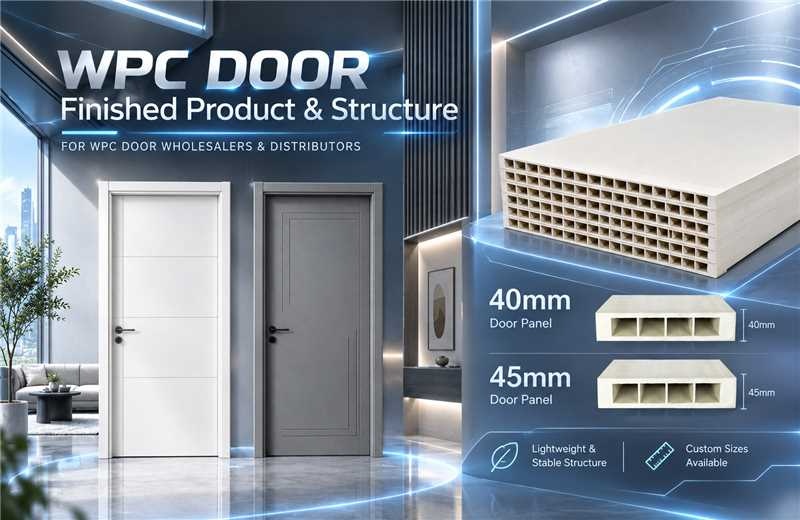
Hollow WPC door cross section

1. Door Construction & Raw Material Inspection

WPC Door Types & Internal Structure

Two common WPC door constructions need different inspections:
  1. Integrated hollow WPC door leaf: one extruded leaf with internal cells and ribs. Request a cut section and a drawing that identifies the cell pattern, rib positions and fixing zones.
  2. Assembled WPC skin door: PVC-film-laminated WPC door skins over a WPC, LVL or wood skeleton, with PU foam board or honeycomb-paper infill and sealed edges. Record the skin, skeleton, filling and edge treatment separately. A skin sample cannot stand in for an integrated hollow leaf.
If a factory will cut a lock opening or fit hinges, pay close attention to material thickness at those machining zones. Thin outer walls leave little room for machining, and a different rib layout can require a different cutout position. Compare sections from the same model; finished weight alone does not show where material sits inside the leaf.

Raw Materials & Cross-Section Quality

WPC compounds PVC resin powder, calcium carbonate and additives, then extrudes the blend at controlled temperature through a precision die. Public PVC resin quotations let buyers see a major input price, but not a supplier’s final formulation. Yingkang has noted quotations around US$20 per tonne apart after an internal formulation change. Compare that gap with the declared raw-material route, recycled content and filler loading rather than reading it as a resin purchasing saving.
Excess poor-quality recycled material, foaming agent or calcium carbonate may leave brittle edges, irregular cells, pores or visible impurities. These hidden weaknesses often emerge after temperature fluctuation or on-site machining, even if the door surface appears perfect.
Yingkang uses virgin PVC resin and prepares 8,000 tonnes of raw material each month. For the order at hand, ask for the formulation declaration or batch record and inspect a representative cut sample. A clean, uniform section is useful evidence, but it does not replace material records or performance tests.
For assembled skin doors, request the WPC door skin specification separately. The source material lists a standard 2 mm skin and customizable 1.8–6 mm options; record the selected thickness, surface treatment, skeleton, filling and edge seal together.

2. Dimensions & Wall Thickness Verification

Door Leaf Size & Thickness

Select the door construction first, then confirm its available dimensions. Yingkang lists these door-leaf options:
  1. Lengths: 1,900 / 2,000 / 2,050 / 2,100 / 2,200 mm.
  2. Widths: 600 / 610 / 650 / 700 / 710 / 750 / 780 / 800 / 810 / 830 / 850 / 900 / 910 / 950 / 1,000 / 1,100 mm.
  3. Thicknesses: integrated hollow panels 35 / 40 / 45 mm; selected nonstandard assembled doors 42 / 44 / 60 mm.
Yingkang can also customize the size you need to an approved drawing; confirm the chosen construction, tooling, tolerances and order quantity before release. The listed options do not mean every design comes in every size.
Your order must specify the construction type and distinguish finished leaf width and height from the rough opening, clear passage and frame outside dimensions. State leaf thickness, handing, cutout positions and trimming allowance. A revised size needs a matching section, frame and hardware layout; changing only the number on the purchase order creates fitting and quality risks.

Wall Thickness, Profiles & Dimensional Tolerances

The overall leaf thickness is different from its outer profile-wall thickness. Yingkang hollow WPC profiles commonly have 5 mm or 7 mm outer walls, subject to model selection. Ask where that measurement is taken and check outer walls and rib locations on a cut section. The approved drawing should state tolerances for leaf size, wall details and hardware machining, with the sample and delivered batch measured at the same marked points.
Wall thickness at the door opening determines frame selection. Yingkang offers frame configurations for finished wall thicknesses of 80–320 mm when the appropriate profile and adjustment range are selected. Nominal frame specifications include 90, 100, 120, 140, 160, 180, 200, 220, 240, 260 and 280 mm, among others. The frame catalogue also lists A, B, D, E, G and T profile families and assembly-frame examples. Measure the finished wall thickness at each opening, then match the WPC frame profile and adjustment range to the wall schedule. Confirm the profile drawing before ordering; a nominal frame size alone does not establish fit.
WPC door quality inspection

3. Surface Finish, Door Frame & Architrave

Surface Finish & Color Consistency

Yingkang offers PVC-film-laminated and painted WPC finishes. A colour name alone is not a technical specification; confirm the process used for the quoted model and inspect the corresponding sample:
  • Laminated finish: check the face, edges, corners and routed details for film alignment and bonding.
  • Painted finish: check coverage and colour at carved areas and edges, as well as the main face.
A colour name alone is not a technical specification. Confirm which finishing process applies to your quoted model. Approve a physical swatch or finished-door sample with the code written on the order, then compare the leaf, frame and architrave together. Lighting and screen reproduction can alter the apparent color. A repeat order should refer to the approved sample, finish process and code, not only a photograph. The available laminated hollow door finishes show design choices, but the ordered appearance still needs a specific reference.

Door Frame, Architrave & Hardware Compatibility

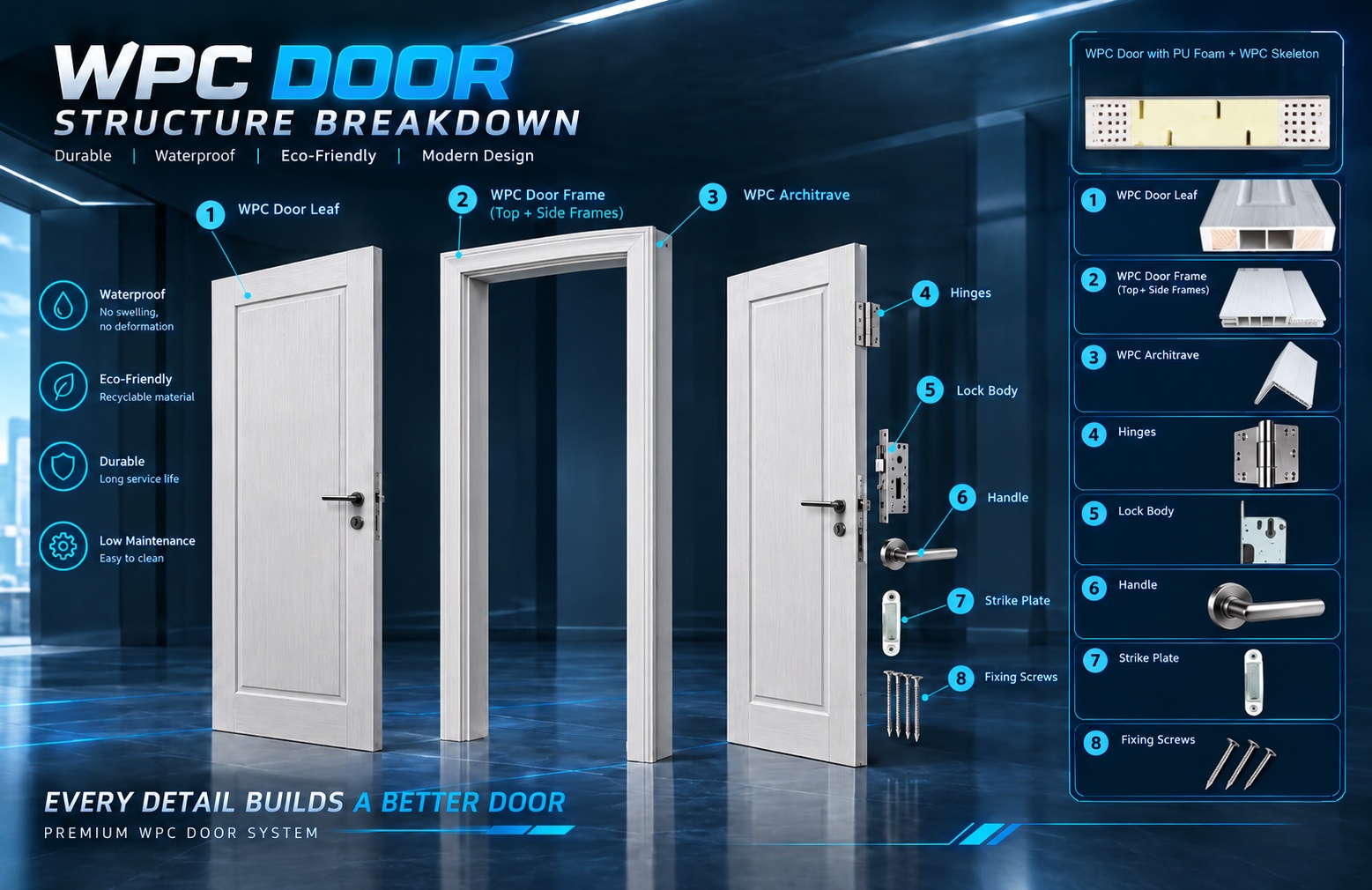
A sound leaf cannot compensate for a frame that misses the wall thickness or a hinge that corrodes in service. Yingkang offers matching WPC frame and architrave profiles and can specify project-grade hinges and quiet locks. As a complete assembly, verify: frame cross-section, adjustment range, architrave coverage, hinge surface treatment, lock body, strike plate and pre-drilled cutouts.
 their shape and width should be specified where they affect the visible finish.
Request an assembled sample for any unfamiliar combination. Open and close it, inspect the leaf-to-frame gap, and confirm that the specified hardware fits without field rework. Moisture resistance of a WPC component does not establish a rating for every accessory or the installed assembly; the project specification should name the environment and required performance.

4. Test Reports & Sample Validation

Third-Party Test Documentation & Moisture Resistance

Yingkang can provide third-party reports or test videos covering water resistance, flame-retardant performance, screw holding, impact and load, together with relevant certifications. Check the issuing body, report number, date, test standard and method, specimen description and result. A test on one panel construction does not automatically apply to a different leaf, frame or installed door set.
For a moisture-exposed project, identify exactly what was tested and how. Did the test use a cut profile, finished leaf or assembled set? Was the frame or surface finish included? Use the same scope check for flame-retardant and mechanical results. A video can show a setup; the report supplies the measured result and test conditions.

Sample Inspection & Quality Consistency

Yingkang supports customer-submitted samples for independent testing and comparison with alternative products. Retain the approved cut section, finished leaf, frame piece and color reference. If the buyer will machine the door, run the sample through the intended cutting and fixing steps. For a project order, assemble the complete set against a representative wall opening.
The full QC traceability chain should connect that approved sample to production: incoming raw material, first-piece approval, dimensional and finish checks, assembly checks, then batch sampling before shipment. Ask which records apply to the quoted model and what acceptance tolerance the purchase order will use. Later batches can then be compared with the same drawing, section and color code.

5. Final WPC Door Buyer’s Checklist

Key Quality Points to Confirm Before Ordering

Check Record on the order Verify with
door Construction Integrated hollow or assembled skin door; section and reinforcement Cut sample and model drawing
Raw material Resin route, filler and recycled-content declaration Material Specification and batch record
Leaf dimensions Length, width, thickness, handing and cutouts Approved drawing and measured sample
Profile details Outer wall, ribs and stated tolerances Marked cross-section measurements
Surface and Finish Lamination or paint; color and design code Physical swatch and finished sample
Complete set Frame, architrave, wall range and hardware Valid third-party test report / certification
Performance standard Required test, specimen scope and result Named report or certification
Repeat Production Control
Approved sample and batch comparison method Retained references and QC record
Resolve incomplete rows before production release. A leaf-only quotation does not cover the frame, trim and hardware required by the opening schedule.
WPC door structure breakdown

6. Get Your Custom WPC Door Sample & Documents

Share Your Project Requirements

Share the following details so Yingkang can match the sample and documents to your order:
  • Door and opening: intended construction, opening schedule, finished wall thickness, leaf dimensions, frame and hardware list.
  • Appearance and processing: target surface process and colour, plus the machining drawing and expected order pattern if your factory will finish the leaf locally.
  • Project performance: installation environment and the test standard specified for the job.

Request Samples & Technical Specifications

Through the Yingkang contact page, request a cut section, finish swatch, matching frame and architrave profiles, a hardware schedule and reports for the selected construction. Compare them against your drawing before approving the production sample. That gives both sides a defined door set to manufacture, inspect and reorder.

Share:
Copyright © 2020 Yingkang All rights reserved.
Technical Support: Coverweb
WhatsApp: +86 18737185148