English 中文
faq

How to Choose a Reliable WPC Door Manufacturer in China

2026-11-07
For importers, distributors, door factories, and project buyers, choosing a WPC door manufacturer means checking the whole supply relationship. The supplier needs to make the right product, 
reproduce the approved specification in bulk, coordinate delivery, and provide support after shipment. Start by verifying the factory, then assess the seven areas below before placing an order.

First confirm who manufactures the doors

Establish whether you are dealing with a manufacturer or a trading company, and identify the factory responsible for your order. Ask which operations the supplier carries out itself and which are subcontracted. This helps you understand who controls production and who will resolve technical issues.
  • Factory ownership and location. Request the factory address, business registration details, establishment date, and information about the production site.
  • Equipment and production lines. Review the equipment used for the product you intend to buy, rather than relying on showroom samples alone.
  • A visible production route. Ask to see material preparation, extrusion, forming, surface treatment, assembly, and packing, with the actual route explained for the quoted door type.
  • Factory access and technical communication. Check whether a live video or on-site factory review can be arranged and whether you can discuss drawings and processing with production or technical staff.
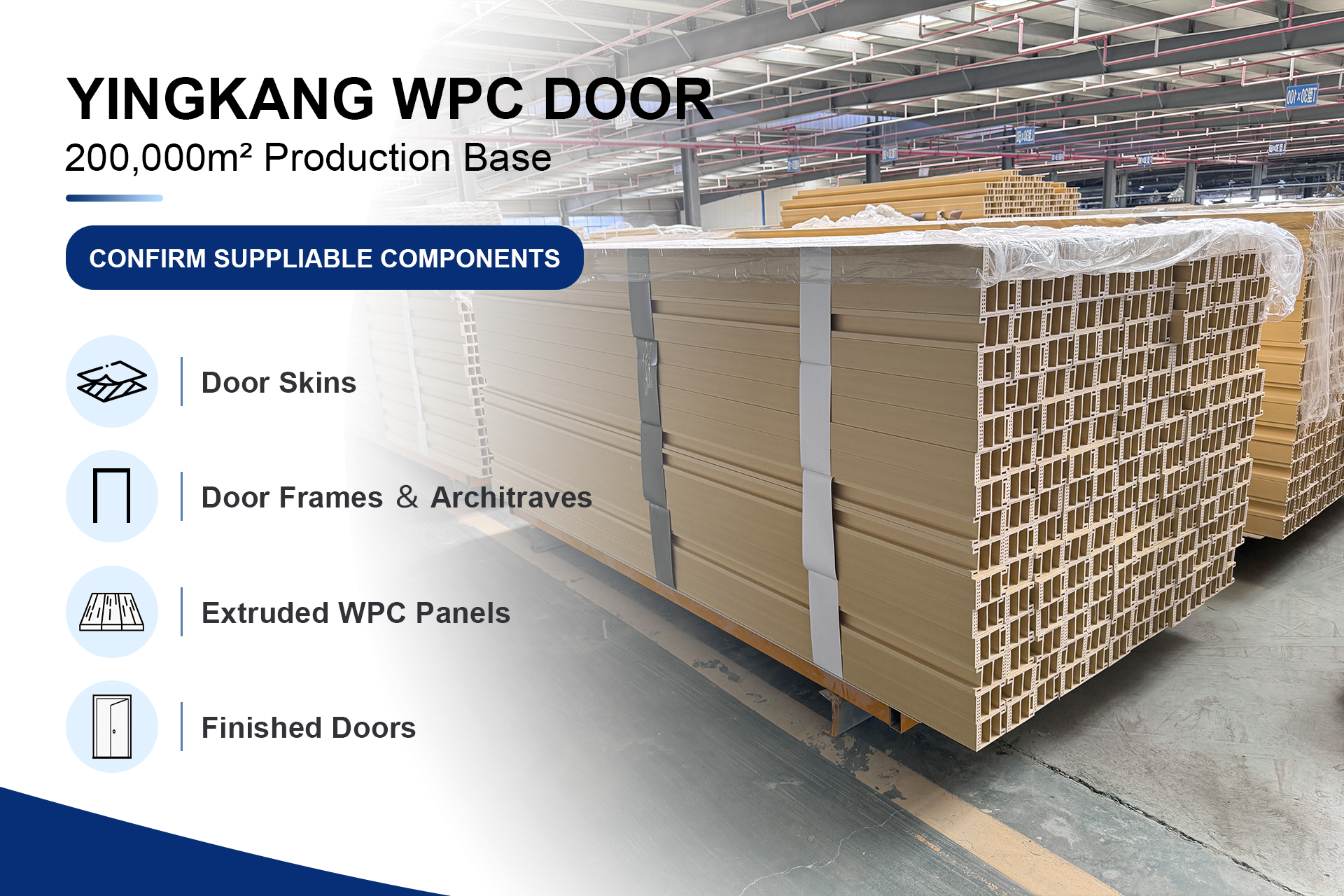
At Yingkang, we began manufacturing in 1997 and operate a 200,000 m² production base with more than 500 employees and a 6,000 m² showroom. Our integrated WPC door production system supports overseas door factories, distributors, wholesalers, and project buyers. Buyers can arrange a factory review and discuss the relevant production stages with our team.

1. Check production capability

Confirm what the manufacturer can actually supply. A door factory purchasing components for local processing has different requirements from an importer buying finished door sets. Compare suppliers using the same product scope, dimensions, thickness, finish, and machining requirements.
Production scope What the buyer should verify
Door skins Available skin designs, sizes, thicknesses, surface options, and suitability for the intended door construction.
Door frames and architraves Profile options, wall-thickness compatibility, and 45° or 90° corner-cutting services for the selected frame system.
Extruded WPC door panels Panel dimensions, thickness, internal profile, surface condition, and suitability for subsequent machining or finishing.
Finished doors Finishing, edge treatment, lock and hinge hole preparation, assembly, complete-set components, and packing.
Our supply range includes WPC door skins, extruded WPC door panels, frames and architraves, and finished doors. Discuss lock-hole and hinge-hole preparation, edge-processing requirements, and frame cutting before approving the drawing. Specify what will be completed at our factory and what your local team will handle.
Ask for available lengths, widths, and thicknesses for the chosen model, together with production capacity and estimated lead time. A quotation should make clear whether it covers the leaf only, components for further processing, or a complete set with the agreed frame, trim, and hardware.

2. Assess quality control capability

Review how the factory manages quality at three levels: incoming materials, production conditions, and finished-product performance. A good sample is useful, but it should be supported by controls that can be repeated across the order.
  • Raw materials. Ask how formulation consistency is maintained, how incoming materials are checked, and how storage and batch identification prevent unintended material changes.
  • Production control. Review extrusion temperature and pressure, material consistency, relevant density controls, dimensional tolerances, and surface quality. Ask which parameters apply to the chosen construction and how deviations are handled.
  • Finished performance. Check water and moisture resistance, termite resistance, dimensional stability, impact performance, and finish quality against the application and specification.
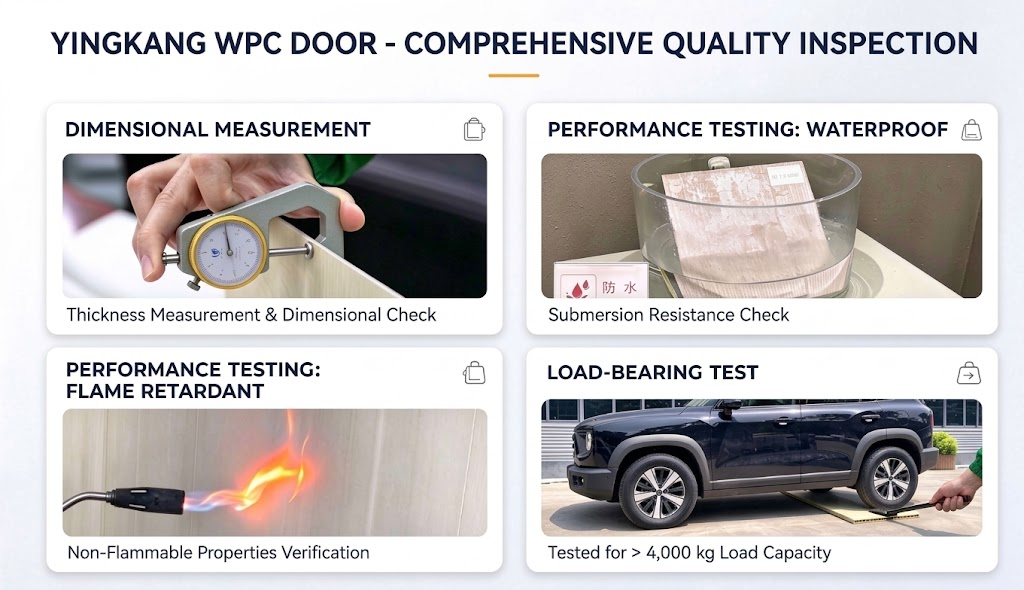
We maintain quality checks across materials, production, and finished products. Available supporting documents include management-system certifications and applicable performance reports or test videos covering water resistance, fire performance, screw-holding, impact, and load testing. Ask our team which evidence applies to your selected model; the construction and test conditions must match the claim being evaluated.
We also support customer-arranged sample testing and comparison with alternative products. Use the same test conditions when comparing results, and distinguish management-system certification from evidence of a particular door’s performance.

3. Evaluate customization capability

A manufacturer should explain what can be customized, what requires a new mould, and how each change affects MOQ, sample preparation, and delivery. “Customizable” becomes useful only when the requested details can be translated into an approved specification.
  • Product customization. Confirm door leaf dimensions and thickness, surface design, color, texture, door skins, frames, and architraves.
  • OEM requirements. Discuss customer-specific designs, brand marks, private labels, customized packaging, and labels. Confirm design ownership and approval responsibilities where relevant.
  • ODM development. Ask how existing factory designs can be adapted through dimensions, finishes, or a market-specific design, and what development work is required.
Our OEM and ODM services cover door leaves, frames, architraves, surface processes, colors, dimensions, packaging, and brand logos. We work with door factories, distributors, wholesalers, importers, and project buyers to develop a suitable product range. Confirm feasibility, tooling, MOQ, and timing for the requested combination before ordering.
Approve drawings, a physical finish reference, machining positions, and packing details before bulk production. For a new design or profile, agree on the sample and approval stages so later changes do not disrupt the production schedule.

4. Check bulk quality and delivery reliability

Capacity matters because it affects supply continuity and project timing. Ask how the factory will allocate production to your order, especially when it includes several sizes, colors, or delivery phases.
  • Production resources. Review the relevant lines, level of automation, daily output, raw-material availability, and ability to run different products in parallel.
  • Scheduling and consistency. Check how batches are planned and compared with approved samples, how peak-season orders are handled, and whether urgent requirements can fit the schedule.
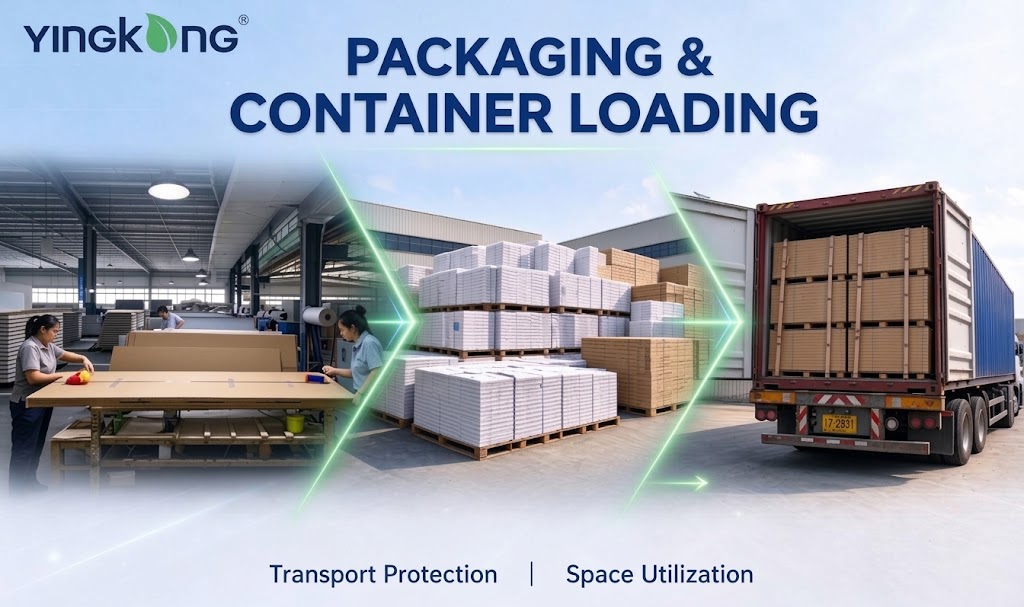
  • Packing and container capacity. Confirm how finished goods are stored, protected, counted, and loaded, and whether loading capacity matches the agreed dispatch plan.
Our finished-door capacity exceeds 3,000 sets per day. Standard orders usually require around 15–20 days after specifications and order details are confirmed. The schedule for your order depends on its quantity, product mix, customization, and approval status, so ask for written timing against the final specification.
For large projects, we can discuss a dedicated production plan and delivery agreement, including phased deliveries where needed. Our team can also review packaging and container-loading arrangements to support transport protection and efficient use of space.

5. Review factory inspection at every order stage

Follow the order through materials, production, quality inspection, storage, and loading. While the previous quality checks establish the factory’s capability, the inspection plan defines what will be verified for your own shipment.
Order stage Inspection points What to record
Before ordering Factory audit, sample evaluation, material review, and manufacturing-process review. Approved samples, drawings, components, finish, tolerances, and test requirements.
During production Incoming-material, first-piece, dimensional, surface, and assembly inspections. Results linked to the order or batch, any deviations, and corrective action.
Before shipment Sampling inspection, quantity reconciliation, packaging inspection, and container-loading checks. Inspection result, packing list, product identification, and agreed loading photos or videos.
Agree on inspection access, sampling, acceptance criteria, and the action required if a product fails a check. Keep the approved specification available throughout production and confirm that packaging marks identify the correct model, finish, and quantity. This gives both buyer and factory a common basis for acceptance.

6. Evaluate export experience and international service

A manufacturer’s export experience should help connect the product specification with destination requirements, packaging, documents, and logistics. We supply customers in more than 150 countries and regions, including the markets below.
Region Markets served
Middle East Israel, Palestine, Saudi Arabia, Kuwait, Oman, Yemen, Iraq, and Syria.
South America Brazil, Argentina, Chile, Colombia, Paraguay, Uruguay, Venezuela, Bolivia, Ecuador, Peru, Guyana, and Suriname.
Europe and the South Caucasus Spain, Portugal, Poland, Serbia, Albania, Montenegro, Romania, Greece, the Netherlands, Azerbaijan, Georgia, Armenia, Ukraine, Croatia, and Kosovo.
Africa Côte d’Ivoire, Kenya, Mozambique, Somalia, Zimbabwe, Senegal, Ghana, Mauritius, Tanzania, Nigeria, South Africa, Burkina Faso, and Guinea.
Asia Thailand, Singapore, Malaysia, Cambodia, Kazakhstan, Uzbekistan, Mongolia, the Maldives, and Myanmar.
North and Central America and the Caribbean The Dominican Republic, Honduras, Costa Rica, Mexico, Guatemala, Puerto Rico, Nicaragua, El Salvador, Jamaica, the Bahamas, Belize, and Panama.
Export history is a starting point. Ask what the supplier can provide for your specific destination and order. Our team supports packaging plans, container-loading optimization, and coordination of customs and international logistics requirements within the agreed supply scope.
  • Market and shipping requirements. Confirm local door standards, applicable certification requirements, packaging, labeling, and container arrangements before production.
  • Documents. Agree on the commercial invoice, packing list, certificate of origin, applicable test reports, inspection documents, and shipping documents required for the shipment.
  • Communication. Check that drawings, quotations, specification changes, production updates, and loading photos or videos can be communicated clearly in English and confirmed in writing.
  • Trade terms. Compare quotations using the same named place and Incoterms version. Clarify responsibilities under EXW, FOB, CIF, DDP, or another agreed term, including freight, insurance, customs clearance, duties, and taxes where applicable.

7. Confirm after-sales support and long-term cooperation

Before the first shipment, establish who will handle installation questions, product issues, replacement components, and repeat orders. A practical service process should specify the contact person, information needed to assess an issue, and how the next action will be agreed.
Our support covers installation guidance, product technical questions, replacement-part coordination, quality claims, shipment damage, and production-related concerns. A dedicated sales manager follows the order and coordinates the response with the relevant team.
If a product cannot be used normally because of a verified quality issue within the warranty period, we assess the circumstances and arrange supplementary supply, replacement, or reasonable compensation under the agreed warranty and order terms. Confirm those terms before purchase, including the evidence required and how transport or handling damage will be assessed.
Long-term cooperation also includes replenishment, repeat orders, and product improvement. Retaining approved drawings, finish references, and component specifications helps both sides plan later orders and discuss changes without losing the agreed product details.

Questions to ask your WPC door supplier

Use these questions in the final supplier discussion and keep the answers alongside the quotation and technical documents.
  • What is the WPC formulation? Ask about the main material components and how the approved formulation is kept consistent in production.
  • Are the materials virgin, recycled, or a combination? Ask how incoming quality and material traceability are checked for the proposed product.
  • How do you control density? Ask which controls apply to this product’s formulation and construction, what is measured, and how variation is managed. Evaluate this alongside performance and dimensional checks.
  • Which tests are available? Request reports or videos relevant to the exact model, application, and destination requirements.
  • How do you maintain consistency between batches? Ask how formulation, process settings, dimensions, finishes, and assembly are checked against the approved specification.
  • Can you provide samples from different production batches? Compare their dimensions, cross-sections, finishes, machining, and applicable performance under the same conditions.
To discuss your order with Yingkang, share your target market, drawings or door schedule, product scope, finish, quantity, and expected delivery phases. We can review a suitable supply route and the samples or technical documents available for evaluation. Contact us through our WPC door inquiry page.
 
Share:
Copyright © 2020 Yingkang All rights reserved.
Technical Support: Coverweb
WhatsApp: +86 18737185148